Skip to content

Composite decks in Bucks & Montgomery County

Composite boards don't need staining or sealing. Wash them once or twice a year. We design the layout with you, get the permit, and build on a pressure-treated frame to code.

Get a Free Quote

Composite decks: what to know

What composite decking is

Composite boards are made from wood fiber and plastic, pressed into boards that look like lumber. They don't rot the way wood does, and they never need stain or sealer.

Almost all boards sold today are capped: a hard plastic shell wraps the core on three or four sides. The cap resists stains, fading, and mold far better than the uncapped boards of the 1990s and 2000s, which gave composite a bad name.

Composite vs. PVC boards

PVC boards, sometimes sold as cellular PVC, have no wood fiber at all. They weigh less and hold up better where water sits, such as near pools or in deep shade. They usually cost more than capped composite.

Both come in many colors and grain patterns, and both are built on the same kind of frame.

What drives the cost

Composite boards cost more than pressure-treated lumber, but the boards are only part of the price. Deck size, height off the ground, stairs, railing type, and how hard the yard is to reach often move the total more than the board line you pick.

Over 15 to 20 years, skipping the stain or sealer a wood deck needs every few years closes part of the gap.

What sits under the boards

Composite decks are almost always framed with pressure-treated lumber. The frame holds the deck up, so it matters as much as the boards you see.

  • Footings that go below the frost depth your township sets, so the deck doesn't heave in winter.
  • A ledger bolted to the house and covered with flashing, so water can't rot the house wall.
  • Joists spaced to the board maker's rules: often 16 inches apart for straight boards and 12 inches for diagonal layouts.
  • Many builders also cover the tops of joists with butyl tape, which sheds water and slows rot in the frame.

Hidden clips or screws

Most grooved boards use hidden clips that sit between the boards, so the surface has no screw heads. Boards at the edges and on stairs are often screwed through the face with color-matched screws.

Composite grows and shrinks with heat and cold, so boards need the end and side gaps the maker calls for.

Heat, color, and grip

Composite gets hot in full sun, and dark colors get hottest. If the deck faces south or west with no shade, a lighter color or a pergola helps. Boards with a deeper grain give better grip when wet.

Upkeep

  • Wash once or twice a year with soap and water or a cleaner made for composite.
  • Clear leaves and pollen from the gaps so water drains. Mold grows on dirt left on the surface, most often in shade.
  • Use a plastic shovel in winter and an ice melt the board maker approves.
  • Scratches in capped boards can't be sanded out like wood, so use pads under grills and heavy furniture.

Railing options

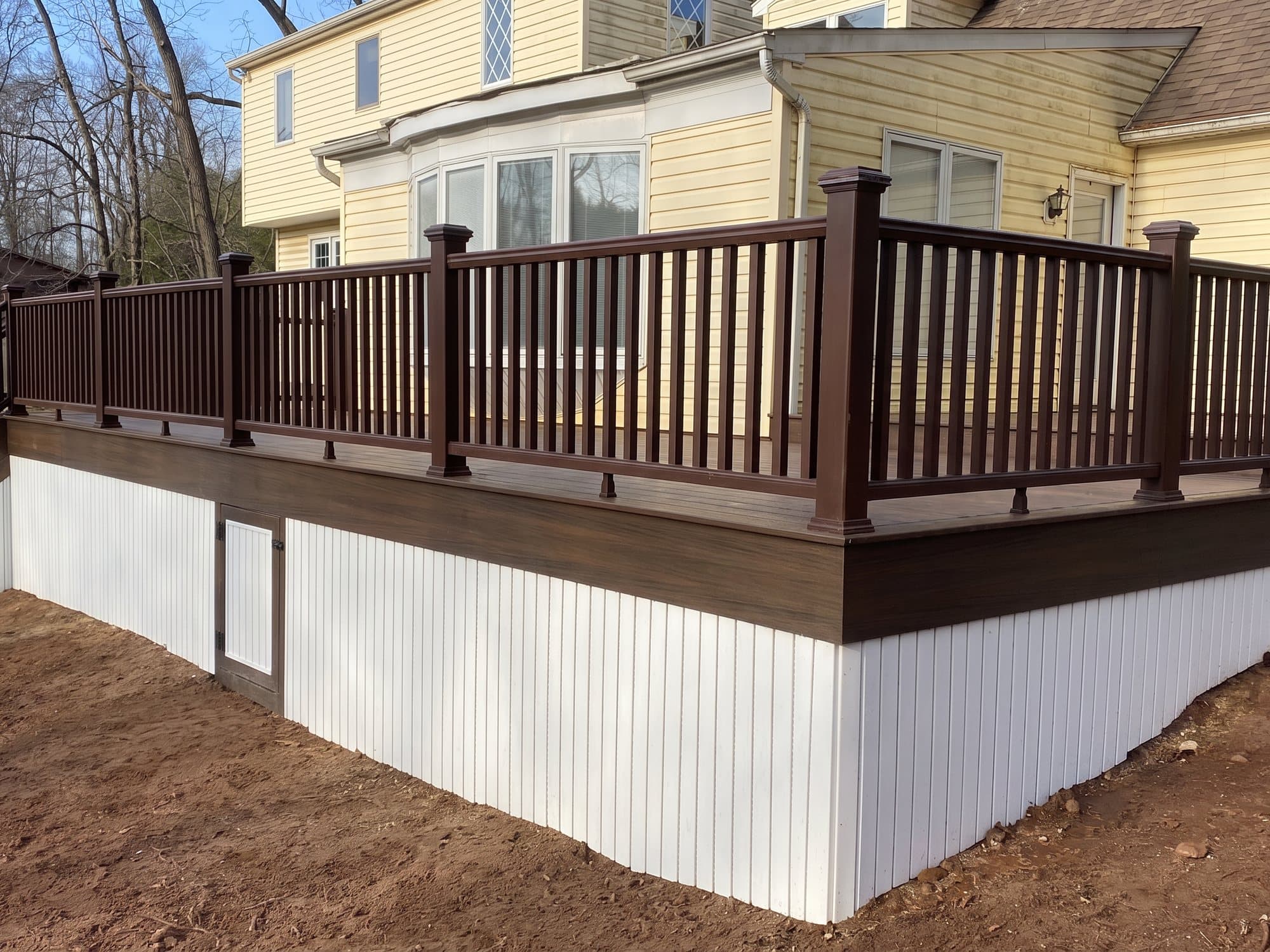
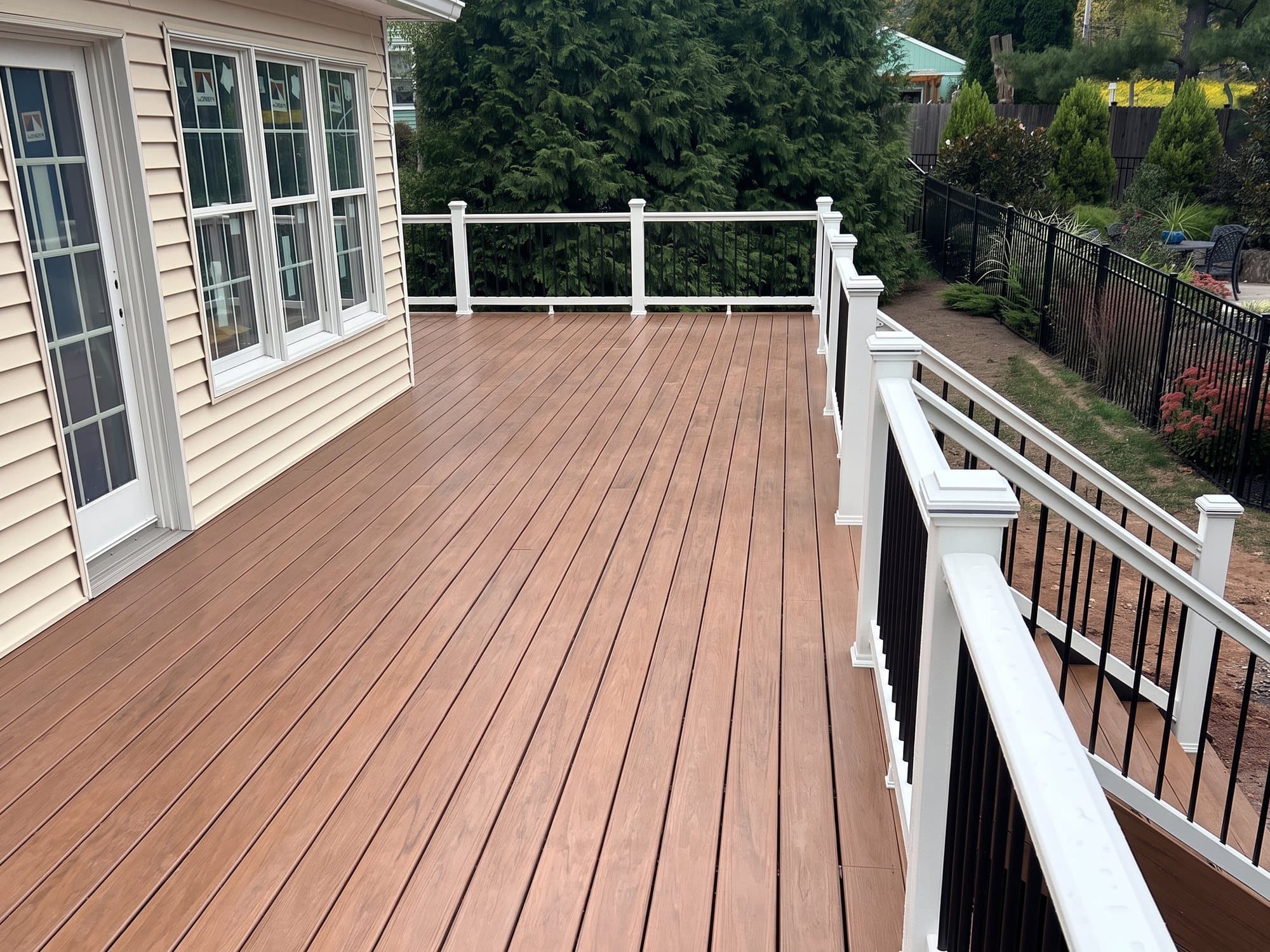
  • Composite or PVC: matches composite boards and needs little upkeep. Usually comes in white, black, and wood tones.
  • Aluminum: powder-coated, won't rust, and has thin balusters that block less of the view.
  • Cable: stainless steel cables for the most open view. The end posts must be strong enough to hold the cables tight, and the cables must stay tight to pass the 4-inch rule below.
  • Wood: the lowest cost. Needs the same stain or paint schedule as a wood deck.

Any deck more than 30 inches above the ground needs a guard at least 36 inches tall, with gaps too small for a 4-inch ball to pass through. Railing posts are a common weak point, so they should be through-bolted or set in tested brackets, not held by a few screws.

Stairs, landings, and multi-level decks

Sloped yards and walkout basements often call for a tall deck or two levels joined by steps. Splitting a high deck into levels breaks up the height, can leave room for a covered patio below, and gives separate spaces for cooking and sitting.

Wide stairs with a landing are easier to climb and can double as seating. Code limits how tall each step is and how shallow each tread can be, and the steps in a flight must match within a small margin. Stairs with four or more risers need a handrail you can grip, a flight can rise only about 12 feet before it needs a landing, and the bottom step should sit on a firm base, not bare soil.

Is composite right for you?

Composite often makes sense if:

  • You plan to stay in the house for years.
  • You don't want to stain or seal every few years.
  • Part of the deck sits in shade, where wood stays damp.
Materials

Composite vs. wood

General differences. Brands and product lines vary, so we'll show you samples at the consult.

Composite

Upfront cost
Higher
Upkeep
Wash once or twice a year. No staining or sealing.
Board warranty
Trex, the brand we prefer, offers 25- to 50-year limited residential warranties, depending on the line.
Rot & insects
Boards resist rot and insects.
Heat in sun
Can get hot in direct sun, more so in dark colors.
Look
Even color and grain; fades a little over time.
Framing
Usually built on a pressure-treated wood frame.

Pressure-treated wood

Upfront cost
Lower
Upkeep
Wash, then stain or seal every few years to limit cracking and graying.
Board warranty
Treated lumber warranties are limited; lifespan depends on upkeep.
Rot & insects
Treated to resist rot and insects; untreated cuts and ends are weak points.
Heat in sun
Stays cooler than most composite.
Look
Natural grain; can be stained any color and refinished.
Framing
Pressure-treated wood frame.

What's included

  • Site visit, measurements, and a written price
  • Layout and board, color, and railing choices
  • Permit drawings and the permit with your township or borough
  • Footings, framing, decking, railings, and stairs built to code

We prefer to build with Trex and install every Trex line. Its boards resist fading, stains, and mold, and Trex backs its decking and railing with limited residential warranties of 25 to 50 years, depending on the line.

How it works

From first call to first cookout

  1. 01

    Consult

    We visit, measure, and talk through how you want to use the space and what you want to spend.

  2. 02

    Design

    You get a layout, material options, and a written price. Changes are easy at this stage.

  3. 03

    Permit

    We prepare drawings and handle the permit with your township or borough.

  4. 04

    Build

    We build to code, pass inspection, and walk the finished deck with you.

FAQ

Composite decks questions

What composite decking do you use?

We prefer Trex. Trex backs its decking and railing with limited residential warranties of 25 to 50 years, depending on the product line. Our own work carries a 1-year craftsmanship warranty.

Should I choose composite or wood?

Composite costs more upfront but needs little upkeep. Wood costs less to start and looks natural, but needs regular staining or sealing. If you plan to stay in your home a long time and don't want yearly upkeep, composite often makes sense. We'll show you both at the consult.

How much does a new deck cost?

As a general estimate, not a quote: our composite decks run about $62–$90 per square foot installed. Height, stairs, railings, roofs, and site access move the price a lot. We give a written price after the consult.

Do I need a permit for a deck in PA?

Usually, yes. Pennsylvania townships and boroughs enforce the state Uniform Construction Code, and most decks need a building permit. Some small, low, freestanding decks can be exempt, but each municipality has its own rules and zoning setbacks, and HOAs may add more. We check with your township or borough and handle the permit.

How long does a deck take to build?

Most decks take a few days to two weeks on site, depending on size and design. Permits often add a few weeks before we can start, and spring and early summer book up first.

Services

What we build

  • Composite decks

    We prefer Trex: low-upkeep boards with matching railings and stairs. No staining, and a wide range of colors and grains.

  • Wood decks

    Pressure-treated or cedar, from single-level decks to multi-level builds for sloped yards. Lower upfront cost and a classic look you can refinish.

  • Deck replacement

    Tear-out of a worn or unsafe deck, or just its railings and stairs, a check of what's underneath, and a new build to current code.

  • Pergolas

    Timber or low-upkeep pergolas over a deck, patio, or outdoor kitchen, for shade and a finished look.

  • Covered decks, patios & porches

    Open-sided roofs, gable pavilions, and screened porches over a deck or patio, so you can sit out in sun, rain, or bug season.

  • Outdoor kitchens

    Stone counters with room for a built-in grill, pizza oven, and storage, on their own or under a pergola.

Service area

Building decks across Bucks & Montgomery County

Bucks County

Montgomery County

  • Lansdale
  • North Wales
  • Souderton
  • Harleysville
  • Hatfield
  • Blue Bell
  • Ambler
  • Horsham

Near these towns? Check your ZIP in the quote form.

Ready to plan your deck?

Get your free quote

Two quick steps. We reply within one business day.

Tell us about your project, or call us directly.

(267) 933-9122

Step 1 of 2

What are you planning?